
Introduction
Cloud security teams rarely suffer from a lack of findings. The harder problem is deciding which findings represent real exposure, which are attached to running workloads, and which deserve immediate attention from developers or incident responders.
Upwind approaches that problem with a runtime-first cloud security platform. It combines agentless cloud scanning with workload sensors and cloud telemetry, then uses live behavior to add context to vulnerabilities, identities, APIs, network paths, data, and threat detections.
This Upwind review examines what that model delivers in practice, where the platform is strongest, how deployment works, what pricing information is available, and which organizations are most likely to justify the investment. The focus is not simply on how many modules Upwind offers, but on whether runtime context produces better security decisions.
What Is Upwind?
Upwind is a cloud-native application protection platform, commonly shortened to CNAPP. Its scope includes cloud security posture management, attack-path analysis, vulnerability management, cloud infrastructure entitlement management, container and Kubernetes security, data security posture management, API security, cloud detection and response, serverless security, application security, managed detection and response, and AI security capabilities.
The platform’s defining idea is “inside-out” visibility. Agentless scanners establish broad cloud coverage, while runtime signals show what workloads execute, how services communicate, which APIs receive traffic, and whether suspicious behavior is happening now.
Upwind supports cloud environments, including AWS, Microsoft Azure, Google Cloud, and Oracle Cloud Infrastructure. Its strongest fit is in cloud-native estates that rely on Kubernetes, containers, virtual machines, serverless services, APIs, and fast-moving development pipelines.
Runtime-Powered CNAPP
<strong>Core Platform Capabilities</strong>
Upwind covers a wide CNAPP surface, but its value depends on how well the modules share context. A posture finding becomes more useful when you can see whether the resource is internet-facing, connected to sensitive data, reachable through an identity, and active in production.
1. Runtime Fabric and Cloud Asset Inventory
The foundation of Upwind is a unified inventory of cloud accounts, resources, workloads, clusters, services, identities, containers, images, APIs, and data flows. Rather than treating each asset as a static record, the platform connects inventory with runtime activity.
The runtime sensor collects kernel-level process, file-system, network, and system activity. Agentless scanners provide broader coverage, so you can begin with read-only scanning and add sensors where deeper context justifies the effort.
2. Cloud Security Posture and Attack Paths
Upwind’s CSPM capabilities identify cloud misconfigurations, policy violations, exposed services, weak encryption, risky storage, logging gaps, and other posture problems across connected environments.
Attack-path analysis connects exposure, permissions, vulnerabilities, sensitive data, and production resources so analysts can focus on combinations that could support compromise or lateral movement. Compliance mappings help organize findings, but they do not replace governance, evidence, access reviews, and exception handling.
3. Runtime Vulnerability Management
Vulnerability scanners can produce thousands of CVEs, many of which exist in packages that never execute or are not reachable in the deployed application. Upwind attempts to reduce that noise by adding live workload behavior and application context.
The platform can prioritize vulnerabilities based on factors such as whether the workload is running, whether a vulnerable function is in use, whether the service is exposed, and whether the asset communicates with sensitive systems. Upwind also supports function-level reachability and runtime call-graph analysis for validating exploitability.
The platform can connect a finding to the workload, image, code owner, commit, and deployment workflow, then route it into remediation tools. Runtime priority should not become permission to ignore dormant vulnerabilities, because exposure can change after a new code path or configuration update.
4. Container and Kubernetes Security
Upwind provides security across container images, Kubernetes configuration, workload behavior, cluster activity, and runtime threats. It can scan images before deployment, correlate image findings with running containers, and identify suspicious processes or network behavior after workloads start.
For Kubernetes, the runtime sensor commonly runs as a DaemonSet. The platform also supports sensorless Kubernetes installation for organizations that want cluster management and posture capabilities without the kernel-level sensor on every node.
During a proof of concept, confirm runtime coverage across your managed clusters, serverless containers, specialized kernels, Windows workloads, and ephemeral environments.
5. Cloud Detection and Response
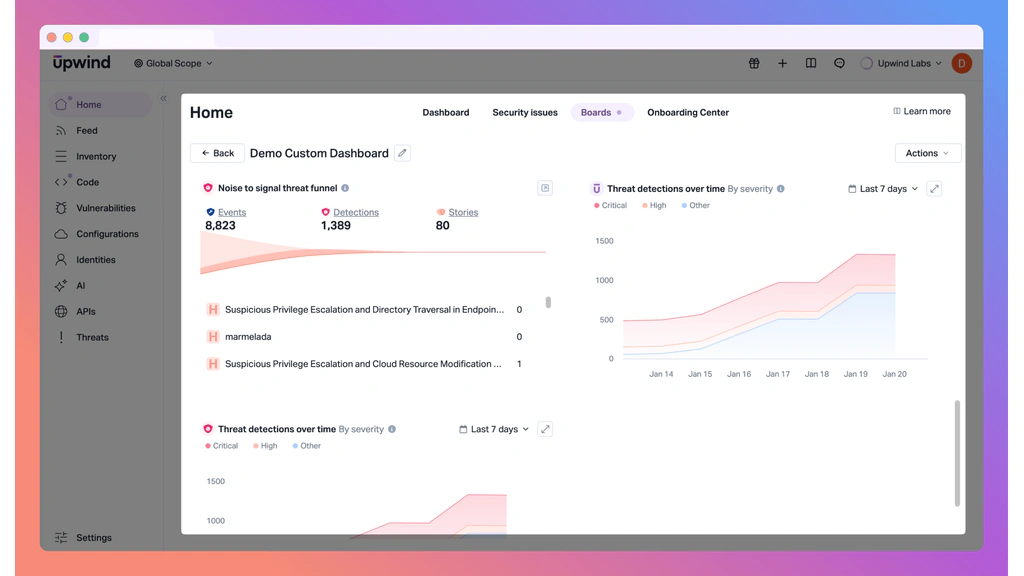
Upwind’s cloud detection and response capabilities monitor workloads and cloud activity for behavior associated with compromise. The platform can investigate unexpected processes, suspicious command execution, malicious network connections, unauthorized access, Kubernetes API activity, file modifications, and other runtime signals.
Runtime context improves investigation by showing the affected process, workload, image, network destination, identity, and surrounding events. Detections can flow into SIEM, ticketing, messaging, monitoring, and automation platforms.
Organizations without a 24/7 security operations function can evaluate Upwind’s managed detection and response offering. As with any MDR service, clarify coverage hours, investigation scope, containment authority, escalation procedures, response-time commitments, data access, and responsibilities shared with your internal team.
6. Runtime API Security
Upwind discovers APIs from live Layer 7 traffic rather than relying only on documentation or gateway inventories. This can reveal shadow APIs, undocumented endpoints, sensitive data flows, externally exposed services, and APIs operating outside approved management processes.
Because discovery is tied to actual traffic, you can see which APIs are active and which workloads serve them. The platform can correlate API behavior with cloud resources, identities, network paths, and runtime threats. It also supports custom detection policies and can identify sensitive data in locations such as headers, query strings, URIs, and request bodies.
Runtime discovery cannot observe endpoints that receive no traffic during the monitoring period, so combine it with code analysis, authentication testing, gateway controls, and API ownership.
7. Identity Security and Cloud Entitlements
Upwind maps human and non-human identities, including users, roles, service accounts, workload identities, and Kubernetes identities. The platform can show permissions, privilege levels, access paths, and whether permissions appear necessary based on observed behavior.
Runtime evidence can show which services and actions are used, supporting least-privilege decisions. Validate ownership and infrequent business workflows before removing permissions.
8. Data Security Posture Management
Upwind’s DSPM capabilities identify and classify sensitive data, then connect that data with exposure, identities, vulnerabilities, resources, and network paths. This improves prioritization because a public storage asset containing regulated or confidential information deserves more attention than an equivalent asset containing non-sensitive test data.
The platform covers supported data at rest and sensitive information moving through APIs. Confirm data stores, regions, sampling, exclusions, classification accuracy, evidence handling, and cost before broad deployment.
9. Application, Supply Chain, and AI Security
Upwind extends runtime context toward build-time security through image scanning, software composition analysis, software bills of materials, infrastructure-as-code checks, admission controls, and CI/CD integrations. The objective is to show developers not only that a component is vulnerable, but whether that component reaches production and executes.
The platform has also expanded into AI security posture and runtime protection. Its current AI coverage includes discovering AI services, models, inference APIs, LLM calls, MCP agents, and shadow AI activity, plus monitoring sensitive data and threats associated with AI workloads.
Specialized AI requirements may still justify dedicated products. Our SaaS and AI application security guide explains how AI guardrails and cloud workload security cover different layers.
Pros and Cons
Advantages and Disadvantages
Upwind has a differentiated technical model, but it is not automatically the best CNAPP for every environment. Its value is highest when runtime visibility materially improves prioritization, detection, and developer collaboration.
Positive
✅ Strong runtime context for prioritization
✅ Hybrid agentless and sensor-based coverage
✅ Broad CNAPP and cloud detection capabilities
✅ Useful developer and security integrations
✅ Deep container, Kubernetes, API, and identity visibility
Negative
❌ Pricing is not publicly transparent
❌ Deepest visibility requires runtime deployment
❌ Broad platform scope can increase evaluation complexity
❌ Smaller public review base than older CNAPP vendors
❌ May be excessive for simple or mostly static cloud estates
👍 Pros
✅ Runtime evidence improves prioritization
Upwind’s most compelling advantage is its ability to enrich posture and vulnerability findings with live behavior. Security teams can spend less time sorting large static lists and more time investigating risks attached to running, exposed, or sensitive workloads.
✅ Broad coverage without relying on one collection method
The platform supports agentless cloud scanners, cloud logs, APIs, and runtime sensors. This gives you a phased deployment path and avoids forcing every security outcome through one architecture.
✅ Strong cloud-native workload depth
Container, Kubernetes, process, network, API, identity, and workload context are central to the platform rather than secondary add-ons. Upwind is especially relevant when production depends on microservices and ephemeral infrastructure.
✅ Good operational integrations
Findings can move into development, ticketing, messaging, SIEM, SOAR, monitoring, and incident workflows. This matters because a high-quality finding still creates little value if ownership and remediation remain manual.
👎 Cons
❌ No public standard pricing
Upwind uses custom proposals and private marketplace offers. This makes initial budget comparison harder and creates a greater need for line-item pricing, workload assumptions, renewal terms, support costs, and expansion scenarios.
❌ Runtime value depends on deployment coverage
Agentless scanning can establish broad visibility, but the most differentiated process and threat context requires supported runtime collection. Organizations with strict change controls, specialized kernels, unmanaged workloads, or fragmented ownership may need more rollout work.
❌ The platform is expanding quickly
Upwind now spans a large set of cloud, application, data, API, identity, and AI security categories. Buyers should verify the maturity, coverage, reporting, and licensing of each required module rather than treating every feature as equally established.
❌ Less independent review history than mature competitors
Public feedback is generally positive, but Upwind has a smaller long-term review footprint than mature competitors.
User Experience
Deployment and Administration
Setup, Coverage, and Daily Operations
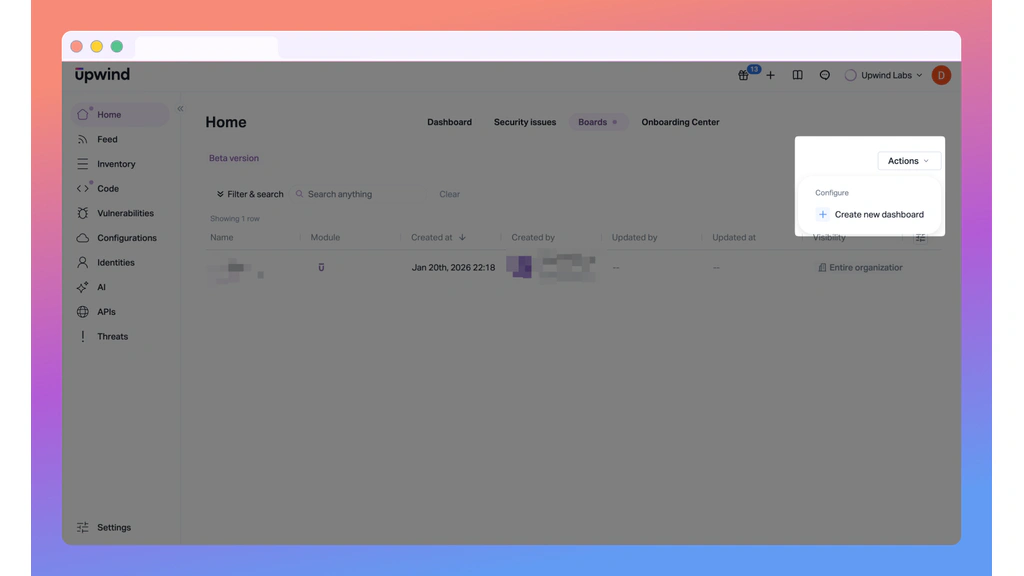
Upwind can begin with cloud-account connections and agentless scanners, then expand into runtime sensors and additional integrations. The exact project depends on the cloud providers, workload types, Kubernetes distributions, security modules, and operational tools you want to cover.
Cloud Account Onboarding
Connecting AWS, Azure, GCP, or OCI typically requires read-only or purpose-built permissions so Upwind can inventory resources, evaluate configurations, and collect relevant cloud telemetry. Organization-level onboarding is preferable when you need consistent coverage across many accounts, subscriptions, or projects.
Before production onboarding, review permission scope, regional data flows, exclusions, role ownership, and the removal process.
Runtime Sensor Deployment
For Kubernetes, Upwind recommends managed installation through its operator and cluster components, with the runtime sensor commonly deployed as a DaemonSet. Host and serverless deployment methods differ by environment.
Start with a non-production cluster, then measure overhead, event volume, compatibility, upgrades, rollback, and coverage in a limited production group.
Console and Workflow Experience
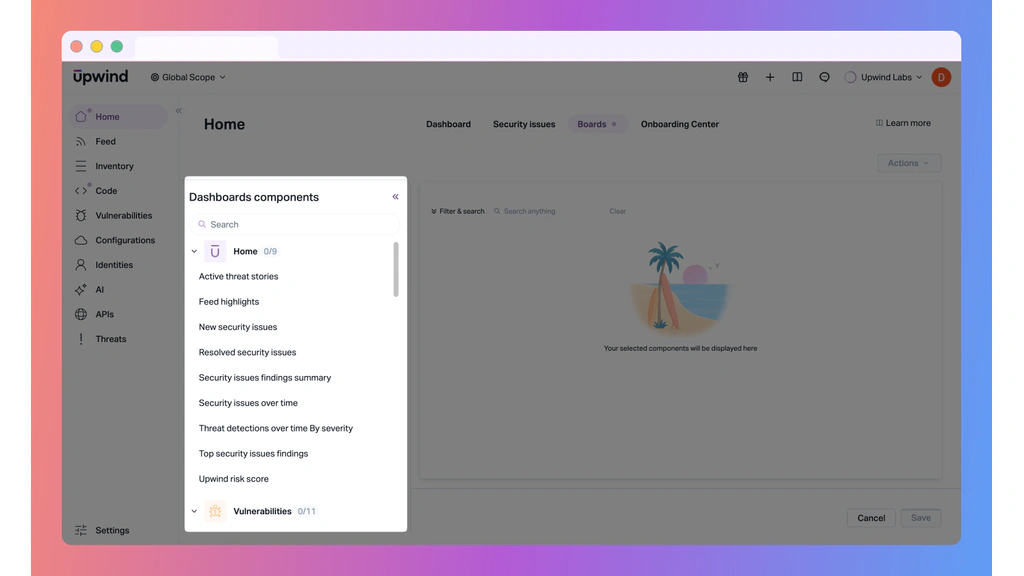
Public customer feedback commonly highlights ease of implementation, useful visibility, and a relatively intuitive interface. The platform’s inventory and relationship model can help analysts move from a high-level risk to the affected resource, identity, workload, process, API, or code owner.
The main challenge is deciding how findings become work. Define owners by account, service, repository, and severity, then prevent duplicate tickets across modules.
Integrations and Automation
Upwind provides a broad integration catalog covering cloud providers, audit logs, CI/CD, application security, ticketing, messaging, SIEM, SOAR, monitoring, compliance, vulnerability response, and managed response platforms.
High-value integrations include Jira and ServiceNow for remediation, Slack and Microsoft Teams for collaboration, GitHub Actions and GitLab for development context, Splunk and Microsoft Sentinel for security operations, and Tines or Torq for automation.
Start with a few workflows tied to measurable outcomes, such as routing exploitable vulnerabilities to the correct team.
Pricing
Plans and Cost
Upwind does not publish standard list prices or simple self-service tiers. Enterprise buyers typically request a custom quote or private marketplace offer. The final cost is likely influenced by cloud scale, workload coverage, enabled modules, runtime sensors, support, managed services, contract length, and marketplace commitments.
| Pricing Element | What to Confirm | Why It Matters |
| Cloud Scope | Accounts, subscriptions, projects, regions, and providers | Broad multi-cloud estates can change licensing assumptions |
| Runtime Coverage | Hosts, nodes, containers, serverless workloads, and sensorless assets | Runtime coverage is central to Upwind’s differentiated value |
| Modules | CSPM, CDR, API, DSPM, CIEM, AppSec, AI security, and MDR | Confirm what is included versus separately licensed |
| Data and Retention | Event volume, retention periods, exports, and overage terms | High-volume telemetry can affect long-term cost |
| Support and Services | Onboarding, support tier, success services, and MDR | Operational assistance may be material to the total cost |
| Renewal | Price protection, growth bands, true-ups, and termination terms | Predictable renewal terms reduce budget surprises |
Compare the complete operating model, including overlapping tools, deployment effort, analyst time, retention, and SIEM ingestion. During a proof of concept, measure alert reduction, owner identification, attack-path quality, and investigation speed.
Platform Trust
Security and Privacy
Upwind is a security platform with access to sensitive cloud metadata, configurations, workload telemetry, identities, APIs, vulnerabilities, and runtime events. Its own security architecture should therefore receive a full vendor-risk review.
Trust Documentation and Compliance
Upwind provides a public Trust Center where customers can review its security posture and request controlled access to compliance and security documentation. During procurement, verify current audit reports, certifications, penetration-test summaries, data-processing terms, subprocessors, business continuity, incident response, and vulnerability disclosure practices.
Do not rely only on a compliance badge. Confirm the exact product scope, audit period, regions, hosting model, and controls relevant to your deployment.
Access and Data Handling
Review the permissions granted to cloud integrations and runtime components. Apply least privilege where supported, protect onboarding credentials, monitor integration-role activity, and document how access is removed during offboarding.
You should also clarify which telemetry leaves your environment, where it is processed, how long it is retained, how tenant isolation works, whether customer-managed encryption options are available, and how data can be exported or deleted.
Runtime Sensor Risk
Kernel-level visibility is powerful because it can observe behavior that logs miss. It also means the sensor becomes a highly trusted component. Review code-signing, update channels, privileges, network destinations, resource limits, tamper resistance, compatibility, vulnerability response, and rollback procedures.
Runtime deployment should follow change-management standards. Test updates before broad production rollout and maintain a documented path for disabling or removing components if they affect workload stability.
Security Assessment
Upwind presents a credible security architecture for cloud-native organizations, especially when the Trust Center documentation and deployment controls satisfy your requirements. The principal risk is not an obvious absence of security features. It is granting broad visibility without fully documenting permissions, telemetry boundaries, operational ownership, and sensor lifecycle management.
Who It Is Best For
Business Fit
| Organization Type | Fit | Why |
| Cloud-native enterprise | Excellent | Benefits from runtime context across containers, APIs, identities, and multi-cloud workloads |
| Kubernetes-heavy engineering company | Excellent | Strong workload, process, image, cluster, and network visibility |
| Security team overwhelmed by CVEs | Strong | Runtime reachability can improve vulnerability prioritization |
| Organization consolidating CNAPP tools | Strong | Broad posture, workload, API, identity, data, and detection modules |
| Small company with one simple cloud account | Limited | Platform breadth and quote-based pricing may exceed requirements |
| Mostly on-premises organization | Limited | Value is highest in dynamic cloud-native infrastructure |
Upwind is strongest where cloud infrastructure changes rapidly and static findings create too much noise. A focused CSPM or scanner may be simpler for small, static, or mostly on-premises environments.
Upwind also does not replace network, endpoint, SaaS, or specialized AI security controls. For example, a CNAPP protects cloud infrastructure and workloads, while tools covered in our Grip Security review follow users and identities into SaaS applications. Our next-generation firewall guide covers another adjacent enforcement layer.
Alternatives
Compare with Others
Wiz – Best for Fast Agentless Cloud Visibility
Wiz is a leading alternative for organizations that prioritize rapid agentless deployment, broad cloud coverage, security graph analysis, posture management, and risk correlation. It is often the easier starting point when you want deep cloud visibility without deploying runtime components across workloads.
Choose Upwind when runtime process, network, API, and workload context is central to the decision. Choose Wiz when agentless time-to-value and a mature cloud risk graph are the stronger priorities.
Orca Security – Best for Agentless Workload and Data Context
Orca Security is known for agentless side-scanning, broad CNAPP coverage, cloud asset context, sensitive data visibility, attack-path analysis, and relatively straightforward onboarding.
Orca is attractive when you want broad coverage with minimal workload changes. Upwind is stronger when you want live process behavior and deeper runtime detection on instrumented workloads.
Sysdig – Best for Open Runtime and Kubernetes Security
Sysdig is a close runtime-security competitor with strong Kubernetes and container depth. Its connection to Falco appeals to teams that value open-source detection rules, transparent runtime signals, and cloud-native security engineering.
Choose Sysdig when Falco alignment and open runtime tooling matter. Choose Upwind when you prefer its unified inside-out risk model, user experience, and broader runtime-to-build-time correlation.
Palo Alto Networks Prisma Cloud – Best for Large Platform Consolidation
Prisma Cloud offers broad enterprise CNAPP coverage across code, cloud posture, workloads, identities, data, APIs, and runtime protection. It is a natural choice for organizations already invested in Palo Alto Networks security and operations platforms.
Prisma Cloud may provide broader ecosystem consolidation, but it can involve complex packaging and administration. Upwind is worth comparing when you want a newer runtime-first experience with focused prioritization. You can also read our Palo Alto Networks Strata review for additional context on the vendor’s wider security ecosystem.
Cisco AI Defense – Best for Specialized Enterprise AI Security
Cisco AI Defense is not a full CNAPP replacement, but it is a relevant alternative when the primary requirement is securing models, AI applications, agents, prompts, responses, and AI supply chains.
Choose Upwind for cloud and workload security with expanding AI coverage. Choose Cisco AI Defense when AI red teaming, runtime guardrails, model security, and enterprise AI governance are the main project. Read our Cisco AI Defense review for a detailed comparison point.
Conclusion
Is Upwind Worth It?
Upwind is worth evaluating when your organization needs more than periodic cloud snapshots. Its strongest advantage is the way runtime evidence connects posture, vulnerabilities, identities, APIs, network paths, data, and active threats.
That context can reduce wasted remediation effort and improve collaboration between security, platform, DevOps, and development teams. The combination of agentless scanners and runtime sensors also gives you a practical path from broad visibility to deeper protection.
The platform is not an automatic choice for every company. Quote-based pricing limits transparency, the deepest value depends on runtime coverage, and the expanding module set requires careful validation. Smaller or mostly static environments may obtain sufficient value from simpler agentless tools.
Before purchasing, run a proof of concept using real production patterns. Measure coverage, sensor overhead, vulnerability reduction, attack-path quality, detection fidelity, API discovery, owner mapping, ticket workflow, and investigation speed. Request a proposal that clearly separates modules, workloads, support, retention, MDR, renewal terms, and expected growth.
For cloud-native enterprises overwhelmed by static findings and need to understand what is happening inside running workloads, Upwind is a differentiated CNAPP platform to consider.
Frequently Asked Questions
Have more questions?
Upwind Frequently Asked Questions
-
What is Upwind?
Upwind is a runtime-first cloud-native application protection platform. It combines agentless cloud scanning, runtime sensors, cloud telemetry, and integrations to secure cloud configurations, workloads, containers, Kubernetes, APIs, identities, data, vulnerabilities, and active threats.
-
How does Upwind differ from an agentless CNAPP?
Upwind offers agentless scanning but also uses runtime sensors to collect live process, network, file-system, and workload activity. This runtime evidence helps validate exposure, prioritize vulnerabilities, discover active APIs, and investigate threats inside running workloads.
-
Does Upwind require an agent?
Not for every capability. Upwind can begin with agentless cloud scanners and cloud-account integrations. Its deepest runtime visibility and threat detection require supported runtime sensors or workload-specific components. Sensorless Kubernetes installation is also available for selected coverage.
-
Which cloud providers does Upwind support?
Upwind supports major cloud platforms including Amazon Web Services, Microsoft Azure, Google Cloud, and Oracle Cloud Infrastructure. Exact resource, workload, serverless, identity, and data coverage should be validated for your services and regions.
-
Is Upwind good for Kubernetes security?
Yes. Kubernetes and container security are core Upwind strengths. The platform can provide cluster posture, image scanning, workload inventory, runtime process and network visibility, threat detection, identity context, and correlation between build-time findings and running containers.
-
Does Upwind include API security?
Yes. Upwind discovers APIs from live Layer 7 traffic, identifies active and shadow endpoints, maps APIs to workloads and cloud resources, detects sensitive data, and applies runtime detection policies. Combine it with code review, authentication testing, and API governance for complete coverage.
-
How much does Upwind cost?
Upwind does not publish standard list pricing. Buyers request a custom quote or private marketplace offer based on cloud scope, workload coverage, enabled modules, runtime deployment, support, managed services, retention, and contract terms.
-
Can Upwind replace vulnerability scanners and cloud security tools?
It may replace or consolidate some CSPM, container security, vulnerability, API discovery, identity, and cloud detection products. However, consolidation should be validated module by module. Upwind does not replace endpoint, network, SaaS, identity-provider, or every specialized security control.
-
What are the best Upwind alternatives?
Leading alternatives include Wiz for fast agentless cloud visibility, Orca Security for agentless side-scanning and broad CNAPP coverage, Sysdig for Kubernetes and open runtime security, and Prisma Cloud for large enterprise platform consolidation.
-
Who should use Upwind?
Upwind is best for cloud-native enterprises, Kubernetes-heavy engineering organizations, and security teams that need runtime context to prioritize vulnerabilities and investigate threats. It may be excessive for small, static, or mostly on-premises environments.